Chancellor John Healey delivered the UK’s Autumn Budget on October 28, 2026. This was a “steady as she goes Budget”, designed not to rock the bonds market. An increase in taxes for banks was widely expected, although it remains to be seen whether the 15-month 3% increase in the bank surcharge will in fact be prove to be temporary. Thankfully, there was no feared exit charge for individuals leaving the UK, nor was the Capital Gains Tax (“CGT”) uplift on death removed. There were still measures affecting wealthy taxpayers, most notably a 4% increase in income tax on property income and savings taking the rate to 49% for top-rate taxpayers from April 2027, as well as a reduction in the Business Asset Disposal Relief allowance from £1 million to £500,000.
A new Founder’s Relief, coming into effect from April 2027, offers a 10% CGT rate on up to £10 million of lifetime gains. This has echoes of Entrepreneurs’ Relief, though without a requirement for the individual to work in the business. The new relief offers the potential to save up to £1.4million of CGT based on current rates (rather than up to £1 million as used to be the case with Entrepreneurs’ Relief as it then was). However, the more stringent conditions mean that in practice its value may be limited.
Founder’s Relief
The proposals are as follows:
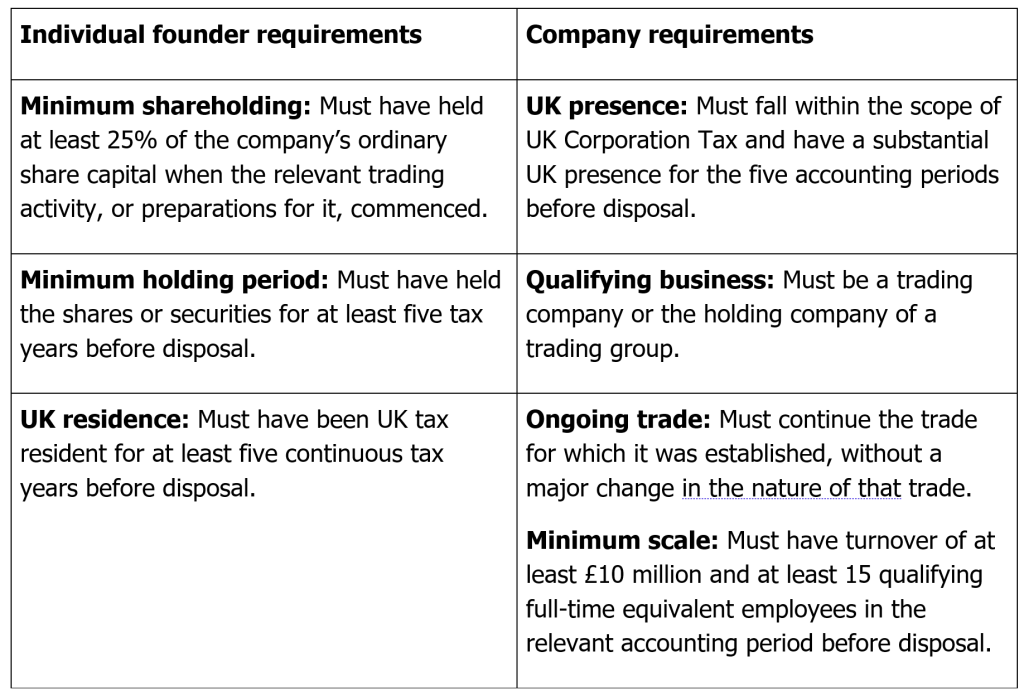
The company must also meet at least 2 of the following 3 conditions:
- Annual average compound growth in turnover of 25% across 3 consecutive accounting periods within the 10 years before disposal, with turnover of at least £10 million in the accounting period before the first of these 3 periods.
- Annual average compound growth of at least 25% in qualifying full-time equivalent employees across 3 consecutive accounting periods within the 10 years before disposal, with at least 15 full-time employees in the accounting period before the first of these three periods.
- The company has; (1) incurred qualifying expenditure of at least £1.5 million on or more on Research & Development (“R&D”) for which it met all the conditions to make an R&D tax relief claim, (2) have claimed R&D tax reliefs for that expenditure for an accounting period or periods ending within the three years before disposal.
The relief is targeted at businesses with significant and rapid growth and scale. Notably, the company must continue the trade it was set up for, with no major change in the nature of that trade. However, it is often the case that start-ups pivot and the direction of trade changes. It remains to be seen how the relief will apply on a management buy-out.
Unlike Business Asset Disposal Relief and its predecessor, Entrepreneurs’ Relief, the new relief will be restricted by excluding companies that engage in certain trading activities. These will be the same as those that are excluded under the Enterprise Investment Scheme, such as dealing in land, financial services or property development.
The conditions of Founders’ Relief look considerably harder to meet than the old Entrepreneurs’ Relief and the current Business Asset Dispoal Relief (“BADR”). A technical consultation, launched on 28 October 2026, sets out the relief and is open until 30 November 2026. It may be that some of the concerns identified are alleviated before the relief is introduced in April 2027.